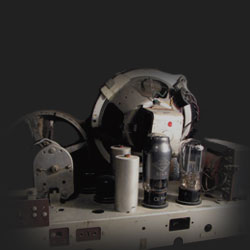
TV receiver "Moskvich-T1"
TV receiver schematic
TV scheme
At the receiver, the image signal has 7 lamps, operating in the following stages: a high frequency power converter with separate local oscillator,two intermediate-frequency amplifier stage, and a detection stage the output stage. The receiver 6 has a sound lamp, not counting the first three lamps in common with the image signal receiver. Audio signals are receiving path, up to the frequency converter with image signals.
 In the screen grid lamp converter is a resonant circuit tuned to the intermediate frequency signal sound. Next is the intermediate frequency amplifier having two stages, then stop, frequency detector and two stages of amplification of low frequency. Furthermore, the receiver has an additional device for fine tuning to the station. Caused by the fact that fine-tuning the FM receiver to the ear is very difficult, and if it is done in moments of shallow modulation transmitter, it is simply impossible. This leads to the fact that the receiver is typically adjusted accurately, begins to distort signals at large and, moreover, significantly increases its sensitivity to transients. For this reason, the FM receiver tuning indicator highly desirable. In this scheme, the amplitude of the intermediate frequency audio channel audio frequency modulated tone. When tuning the receiver, due to the balanced properties of discriminators, audibility of the tone disappears. The source of the modulating voltage relaxation oscillator is used, working on a neon lamp FN2. Modulation is performed by applying a voltage to the anode of sound frequency limiter. Being extremely simple, such a scheme at the same time makes it possible to accurately set the receiver regardless of the modulation of the receiving station. Although the fine-tuning is no complete disappearance of the auxiliary signal, at least still get very sharp. Inclusion of a relaxation oscillator is made to push the rotary knob, when the handle is lowered it by the spring returns to its original position and the generator is switched off. TV operating experience has confirmed the feasibility of introducing the scheme described adjustment indicator.

TV scan
Deploying the Receiver collected by a simple and reliable schemes. The TV is used with an external excitation scheme of blocking oscillator and the use of auxiliary kenotron. Scheme distinguishes the absence of a discharge lamp and that the formation of a sawtooth current is directly off the lamp and auxiliary rectifiers. In this circuit, the lamp acts as a key, the locking of the opening and the anodic circuit, i. e. Here the lamp stands approximately in the same mode as the current in the generator, the generator and therefore consumes a relatively small current. The output of the transformer can be made simpler than the transformer to a current generator circuit. The scheme is somewhat more complicated current generator, for long it needs three lamps instead of one. However, this complication is negligible, if one considers that in this case there is no need to use powerful and sophisticated lamp output transformer. However, here the drawbacks of the current generator: low stability, the frequency dependence from the amplitude adjustment difficulty of synchronization. As in the case of line scanning, the TV used a modified horizontal deflection circuit. Vertical circuit somewhat simpler horizontal - for it need only two lamps (replaced kenotron resistance). Compared to the oscillator circuit current selected connection Vertical has much better stability and more easily synchronized.
Deflection system
The design of deflection coils receiver system is somewhat more complicated and more expensive than a similar design in televisions 17TN 17TN -1 and 3, but it has a great advantage - allows you to adjust the shape of the raster (mutual perpendicular vertical and horizontal scans). A vertical deflection yoke system is designed so that practically possible to completely compensate for the nonlinearity vertical. This is done in the selection of the gap in the magnetic shunt vertical deflection system. Furthermore, the deflection system can easily be migrated almost all of the coil, which creates an additional convenience for mass production. Applied in a TV "Moskvich-T1" deflection system can be successfully used in large CRT TVs.
Power supply
Power supply anode cathode ray tube carried by the high voltage transformer and then rectified. Higher cost structure by applying a high voltage transformer and filter capacitors is justified by good resistance to work. For convenience and simplicity of switching winding high voltage transformer primary winding is fed from a common heater circuit current of 6.3 V. the primary circuit at 6.3 V at 1.6 A reaches rectified voltage is 4 kV.
The scheme features
Frequency unit consists of UHF (lamp L7), mixer (lamp L8) and LO (lamp L13). High-frequency amplifier circuit is assembled by sequential resonant circuits with power circuits in the grid and anode. To expand the bandwidth circuits shunt resistance, the role of which in some cases operate resistance in the circuits of the control grids lamps (resistance R32 and R37). Contact with the antenna autotransformer, designed for connection asymmetric feed line with a characteristic impedance of 75 ohms. Gain is adjusted by changing the magnitude of the negative voltage on the control grid of the tube and UHF mixer, where it passes through the decoupling filters (resistance R29, R33 and capacitors C34, C40). Resistance R31 and R36 together with the capacitors C36 and C42 form a decoupling filters in the anode circuits. Heterodyne on the lamp L13 assembled three-point circuit to the cathode connection. Lamp L8 - mixer operating mode single grid converter.
Video. In the IFA channel images (lamps A9, A10) applied single circuit tuned to different frequencies in the passband and small shunted resistances. A4 detector lamp operates as a half-wave detection. DR1 serves to throttle bandwidth of the constant component of the detected signal. With load detector image signal is supplied to a single-stage video amplifier (bulb A12). Chokes and Ap2 Dr3 serve to correct the frequency response at high frequencies, and the resistance R52 and capacitor C57 - at low frequencies.
Audio channel. In the screen grid circuit mixing lamp L8 included circuit L1, C2, tuned to the intermediate frequency sound. In the IFA channel sound stage two (lamps L1 and L2). Lamp L3 - limiter and P4 - frequency detector. Audio-frequency voltage is removed from the load resistors R14 and R15, and through switch " tone - pickup - Radio" arrives on the grid lamp L5 - the first stage of the VLF.
Synchronization unit. Branch synchronization signals from the composite video signal is produced left triode lamp L16. To the anode load resistance of this lamp to highlight lowercase clock connected differential filter formed by capacitor C67 and the resistance of the anode side of the transformer blocking oscillator, and to highlight the half-frame clock is used integrating circuit consisting of resistors R72, R73, R74 and capacitor S73, C74 and C75.
Scanner. Scan the rows by right- triode lamp L16, performing the role of blocking oscillator, and a lamp L17 - sawtooth generator current. Lamp L18 - damper. In the scheme of vertical deflection work lamp L19 and L20, L19 of which lamp - blocking oscillator, and the lamp L20 - sawtooth voltage amplifier pulse shape.
Directly in the anode circuit of the output tube L20 included vertical deflection coil Dr5, core collected from the plates of transformer steel. Poles of the core cover neck of the tube. Vertical linearity adjustment is made by means of a magnetic shunt constructed as a U- shaped core. Raster centering in the vertical direction is performed using coils and Dr7 Dr8, planted on the main core. Magnitude of the current alignment is controlled by the potentiometer R91. Choke Dr6 necessary to reduce the shunting effect centering coils.
High-voltage rectifier. Power supply anode kinescope made for using a high-voltage transformer and rectifier Tr2 lamp L14. Low-voltage rectifier works on the lamp L15.
< Previous |
Comments: Add comment:
| Name: | ||
| code protection:* | ||
| email:* | ||
 Main
Main- About
- Antique radios
- Old Radio Collecting
-
Radio repair links
- Old Radios Troubleshooting Quick Guide
- Tube radios repair technology
- If you receive the parcel with an old radio